Why Most Founders Hire Too Early — And What It Costs Them
The hardest mistakes I have made in 25 years of building companies were in hiring. Hiring too early. Hiring from job boards. Hiring people I “clicked with” but who couldn’t actually do the job. Here are the four patterns I see most often — and the real cost of each.
By Shawn Ennis · Founder & CEO, Kinetic Tricks · June 8, 2026
I remember founding my first company. I worked nights. I worked weekends. I worked holidays. My wife learned the rhythm of my laptop closing at 1am. My kids learned that “Dad’s working” was a complete sentence. I told myself this was temporary — that once I hired the right people, I’d get my life back.
That was a lie I told myself for years.
The hiring I did successfully caused problems I’m still paying for a decade later. The hiring I did unsuccessfully cost me money, momentum, and at least one relationship I valued. And the hiring I avoided — when I should have pulled the trigger — cost me opportunities I’ll never recover.
If you’re a founder reading this, you already know what I’m describing. You’ve had the conversation in your head a hundred times: “I need to hire someone for sales. I need to hire someone for marketing. I can’t keep doing all of this myself.”
You’re probably reading this on a Sunday. Or at 11pm on a Tuesday. Or during what should have been your kid’s soccer game.
Let me tell you the four hiring patterns that almost ended my last company before AI agents existed to give me a different option.
Pattern 1: Equity-paid employees
Cash is scarce in the early stages. Equity feels free. So you hire your first sales person with $40K salary and “meaningful equity.” You tell yourself this aligns incentives. You tell yourself they’ll work like a founder because they have founder-level upside.
They won’t.
Equity-paid employees calculate their effective hourly rate based on the cash, not the equity. The equity is lottery money in their mental accounting. When work gets hard, they leave. When they leave, they take your equity with them, and now you have a dead cap table that makes future fundraising harder.
I’ve made this mistake. Twice.
Pattern 2: Mr. Right Now instead of Mr. Right
You spend three months looking for the perfect VP Sales. You interview twenty candidates. None are perfect. You’re tired. You’re falling behind on pipeline. Your board is asking questions.
So you hire the best of the twenty. You tell yourself, “We can make it work. I’ll coach them up.”
Eighteen months later, you’re paying severance to someone who never figured out your product, never closed a deal that you didn’t help close, and is now telling their next employer that your company was “directionless.”
You weren’t directionless. You were undisciplined about hiring under pressure. Those aren’t the same thing, but the result is identical: wasted money, wasted time, and an empty seat that’s somehow more demoralizing than the empty seat you started with.
Pattern 3: Recruiting as a 25% job
When you’re founder-led on sales and trying to find product-market fit, every hour matters. The math is unforgiving: you need to be on customer calls, refining the product, understanding the market.
So when you decide to hire, you don’t budget for recruiting properly. You think you’ll squeeze it in. You’ll post a job, do interviews in lunch breaks, decide on a Sunday night.
What actually happens: recruiting eats 25% of your time for three to six months. The customer calls suffer. The product work stalls. You hire someone — maybe good, maybe not — but during the months you spent recruiting, you also lost momentum on the part of the business that needed your attention most.
Recruiting is a job. When founders try to do it part-time, the company pays the price twice: once in the hire and once in the things that didn’t get done while you were hiring.
Pattern 4: Hiring because you “think” this is the fit
Founders have intuition. It’s one of the things that makes us founders. But intuition is unreliable for hiring decisions, because we’re optimizing on personality, energy, vision alignment — qualities that are real but don’t necessarily predict job performance.
I’ve hired people I loved who couldn’t sell. I’ve hired people I clicked with who couldn’t manage their own calendar, let alone a team. I’ve hired people I “knew were the one” who turned out to be the one for a different company entirely.
The version of you that’s certain about a hire is almost always wrong. The version of you that’s hesitant is almost always more accurate. But you hire the certain ones anyway, because doubt feels like a leadership failure.
It isn’t. Doubt is data.
What it actually costs you
When a founder hires badly, they pay three costs.
The financial cost. A bad sales hire costs $150,000 to $250,000 in salary, benefits, ramp time, and severance. A bad marketing hire is similar. A bad executive hire (VP, Director) can cost $500,000 or more once you factor in equity dilution and recruitment fees. These are real numbers, and they show up on your P&L.
The opportunity cost. Every month the founder spent recruiting was a month not spent on customers, product, or strategy. Every month the founder spent managing the bad hire was a month not spent selling, building, or thinking. The hire was supposed to free the founder’s time. Instead it consumed it. For a founder generating significant personal pipeline, six months of recruiting and managing a bad hire often costs more in opportunity than the direct financial cost.
The reputational cost. This is the cost founders never talk about, but it’s the most expensive. When you hire someone from your network and they don’t work out, the entire network knows. When you lay someone off, the entire network knows. When word gets out that you’re a difficult manager, an unclear communicator, or a poor judge of talent, the doors to future hires from your network close.
You don’t get those doors open again. The senior salesperson at the Tier 1 customer who would have been your perfect VP Sales hire in three years? They’ve heard the stories. They will not return your call.
A bad hire isn’t a $200K mistake. It’s a $200K mistake plus a permanent reduction in your ability to make future hires from the only pool that matters.
You don’t have to hire as early as you think
Here’s the thing nobody told me when I was building my first company, and what almost nobody is talking about now even though it’s the most important shift in early-stage GTM in twenty years:
The traditional milestones — “first sales hire at $1M ARR,” “first marketing hire at $2M ARR,” “VP of Sales at $5M ARR” — were built for an era when there were no alternatives. The founder did the work or someone else did the work. There was no third option.
There is now.
Over the past three weeks, I generated a meaningful pipeline for my current company. I am the only person doing GTM. No sales hire. No marketing hire. No ops hire. My LinkedIn impressions are up 683% over the prior 90 days. I have five inbound requests from people outside my professional network — something that almost never happens for founders. My CRM is accurate for the first time in my 25-year career, because I’m not maintaining it manually.
I’m not telling you this to brag. I’m telling you because I’ve spent two decades wishing this was possible, and now it is.
If you’re considering a sales or marketing hire right now, you have three questions to answer first:
- Whether you should hire at all (and if so, when)
- What kind of person you should hire (and what kind you absolutely shouldn’t)
- What you should do instead of hiring if the answer is “not yet”
Most founders I know tell me their biggest professional mistakes were in hiring. Yours don’t have to be.
The framework that prevents this
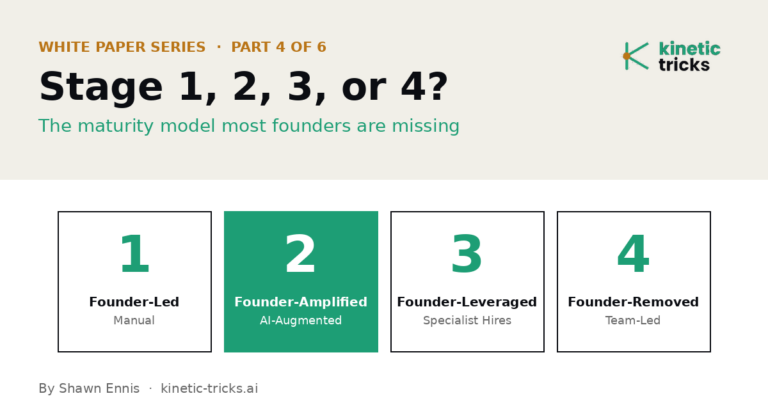
I wrote a white paper that walks through the complete framework — including a four-stage maturity model that tells you exactly which stage you’re in, the time allocation rule that makes solo-led GTM sustainable, and the three mechanisms that replace your first sales hire.
It’s 31 pages. It’s free. It’s the playbook I’m running at my current company right now, in real time.
Get the full framework: Avoiding the Hiring Trap
A 31-page framework for solo founders deciding when AI agents are enough and when humans are essential. Free download. No spam. Download the white paper →