Stage 1, 2, 3, or 4? The Maturity Model Most Founders Are Missing
Most founders place themselves in Stage 3 when they’re actually in Stage 1. The gap is what’s hurting them. Here is the four-stage model — and why Stage 2 is the new default that almost nobody is operating in yet.
By Shawn Ennis · Founder & CEO, Kinetic Tricks · July 9, 2026
Every successful company moves through stages as it scales. Understanding the stages — and where you are in them — is critical to making good hiring decisions.
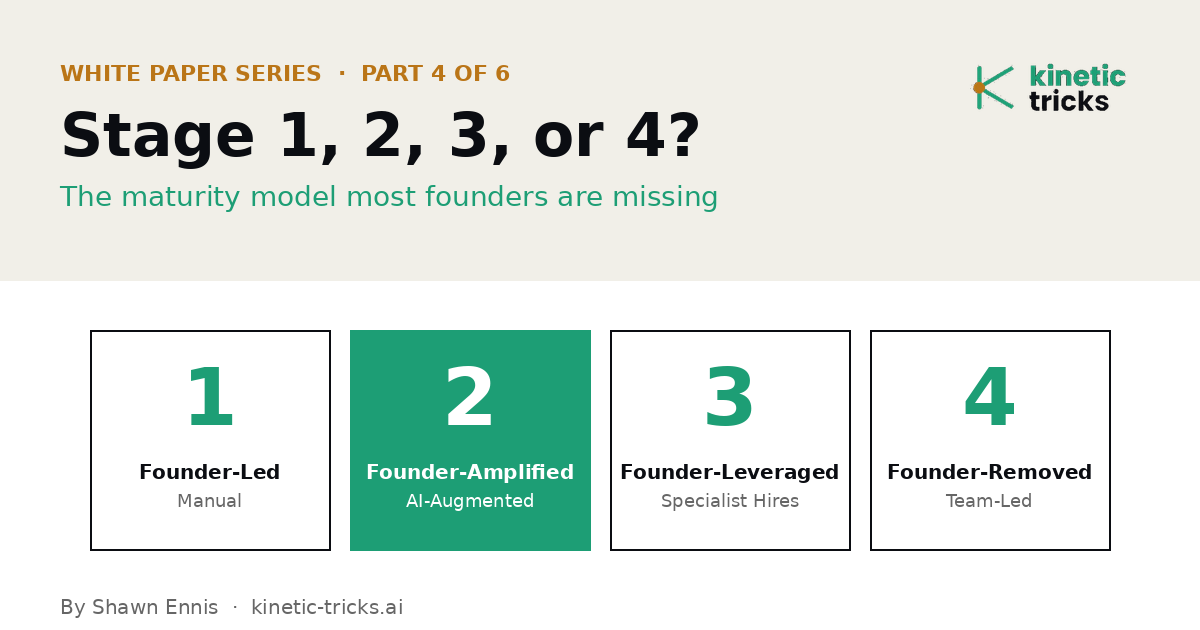
There are four stages. Almost no founders accurately place themselves in the right one. The mismatch is what causes premature hires, missed opportunities, and the burnout that drives founders to make bad calls under pressure.
Let me walk you through each stage. As you read, locate yourself honestly. Most founders reading this will discover they’re in an earlier stage than they thought.
Stage 1: Founder-Led (Manual)
The founder does everything themselves, without significant automation. Outreach is manual. Content is manual. CRM is updated by hand, when there’s time. Pipeline review happens in a spreadsheet.
This is the default state. Every company starts here. Most founders survive this stage for the first $200K-500K in revenue, sometimes longer if they’re working unsustainable hours.
Characteristics of Stage 1:
- Founder is the bottleneck on everything
- Pipeline is unreliable because data entry lags
- Content production is sporadic
- Outreach happens in bursts, then stops
- The founder regularly works 60-80 hour weeks
- Growth is proportional to founder energy
Stage 1 is sustainable for 6-18 months. Beyond that, founders burn out, miss opportunities, or hire prematurely.
Stage 2: Founder-Amplified (AI-Augmented) The New Default
The founder is still the only GTM resource, but software now handles the work that doesn’t require human judgment. AI agents draft outreach, maintain the CRM, generate content, prepare meeting briefs, and surface pipeline signals. The founder reviews, approves, and executes the human-judgment work: actual conversations, deal architecture, strategic decisions.
This is the stage that used to be impossible and is now the most valuable place to be. Almost no founders are operating here today because the tools have only existed for about two years.
Characteristics of Stage 2:
- Founder is still the only GTM person, but operates at 3-4x their Stage 1 capacity
- Pipeline is accurate because data capture is automated
- Content production is consistent and compounding
- Outreach is continuous and personalized
- The founder works 40-50 hours and is more productive than in Stage 1
- Growth becomes proportional to founder strategy, not founder energy
Stage 2 is sustainable indefinitely for companies that don’t need rapid scaling. For companies targeting $5-10M ARR, Stage 2 can be the steady state, never moving to Stage 3.
For companies targeting larger outcomes, Stage 2 buys time. Time to find product-market fit. Time to generate traction data. Time to build the network from which future hires will come.
Stage 3: Founder-Leveraged (Specialist Hires from Network)
The founder makes targeted hires, but only for specific functions where AI cannot substitute and where the work has clear billable outcomes. These are specialist roles, not generalist roles. They are filled by people from the founder’s network, not from job boards.
Typical Stage 3 hires:
- A senior closer who only handles late-stage deals (because deal architecture is a human skill)
- A customer success lead who manages existing accounts (because relationship management is a human skill)
- A sales engineer who delivers technical demos (because deep product expertise is a human skill)
- A partner manager who handles strategic relationships (because reading complex multi-stakeholder situations is a human skill)
What does NOT get hired in Stage 3:
- A generalist SDR (AI agents handle outreach)
- A content marketer (AI agents handle content production)
- A sales operations person (AI agents handle CRM and pipeline ops)
- A demand gen specialist (AI agents handle this)
Stage 3 starts when the founder has identified a specific revenue-generating activity that requires human judgment beyond what they can provide alone. Each hire is justified by a specific outcome, not by an arbitrary milestone.
Stage 4: Founder-Removed (Team-Led)
The founder steps back from day-to-day GTM execution. A VP of Sales, a Head of Marketing, or a Chief Revenue Officer runs the function. The founder focuses on strategy, vision, key relationships, and the next phase of the business.
This stage requires meaningful scale — typically $5M+ ARR with a clear path to $20M+ — to justify the cost of the leadership layer.
Stage 4 hires are also from the founder’s network, but they’re more senior and more carefully evaluated. The cost of a bad VP hire is multiples of a bad specialist hire.
Why Stage 2 is the new default
For decades, founders moved from Stage 1 directly to Stage 3 (or Stage 4 if they had funding). Stage 2 didn’t exist as a viable option, because the tools to amplify a single founder didn’t exist.
This has changed.
AI agents now handle:
- Outreach drafting at scale, with the same personalization quality as a human SDR but at one-tenth the cost and time
- Content production, drafting blog posts, social media, email sequences in the founder’s voice, at the cadence the algorithm rewards
- CRM maintenance, capturing every interaction, every contact, every signal, with accuracy a human can’t match because humans don’t have time
- Pipeline analysis, surfacing changes, signals, and recommended actions every morning
- Meeting preparation, compiling context on every account and attendee before every call
- Knowledge management, making the founder’s accumulated expertise available as a resource for every interaction
When all of these are running, the founder does the work that AI cannot do: the conversations, the deal architecture, the strategic thinking, the network cultivation. The work that requires human judgment.
This is what makes Stage 2 viable. Not because AI replaces the human, but because AI removes the work that didn’t require a human to begin with. The work that founders historically had to hire to offload, because they couldn’t do it themselves and software couldn’t either.
That category of work has collapsed. What used to require a sales operations hire is now a software feature. What used to require an SDR is now a software feature. What used to require a content marketer is now a software feature.
The math of skipping Stage 2
The founder who recognizes this and uses it can stay in Stage 2 long enough to:
- Reach $3-5M ARR before making the first hire
- Generate the traction data that makes Stage 3 hires successful
- Build the network from which Stage 3 hires will be sourced
- Validate product-market fit before betting capital on people
The founder who doesn’t recognize this — who follows the old playbook and hires at $1M ARR because that’s “when you’re supposed to” — will spend the next two years managing hires instead of growing the company, and will arrive at $3-5M ARR with the same team a Stage 2 founder will have arrived at $3-5M ARR without hiring at all.
The difference: the Stage 2 founder has 2-3 million dollars of unspent payroll, a higher-quality CRM, and a team of one that runs faster than the Stage 3 founder’s team of four.
Where are you actually?
Answer honestly. Most founders misjudge their stage, almost always overestimating themselves.
You are in Stage 1 if:
- You write your outreach messages yourself, one at a time, when you have time
- Your CRM is mostly accurate for deals you’re actively working but degrades for everything older than 30 days
- You post on LinkedIn when something interesting happens, which is irregularly
- You haven’t published a piece of content longer than a LinkedIn post in the past 60 days
- Your morning routine involves checking email and reacting to whatever showed up
- You frequently work past 8pm because “you’ll catch up tonight”
- You’ve considered hiring a sales person multiple times this year
If three or more of these are true, you’re in Stage 1. This is fine — every founder starts here — but it’s not sustainable for more than 12-18 months without breaking either you or the business.
You are in transition from Stage 1 to Stage 2 if:
- You’ve started using AI tools for specific tasks (drafting emails, generating content)
- You’ve automated at least one workflow (calendar booking, lead routing, follow-up reminders)
- You can articulate your ideal customer profile in one sentence
- You have a written content strategy, even if you don’t always execute it
- Your CRM has more accurate data than it did six months ago
This is the right place to be moving toward. Most founders in this transition are using a patchwork of tools and getting some benefit. The goal is to consolidate the patchwork into a coherent operating system.
You are in Stage 2 if:
- AI agents handle the work that doesn’t require your judgment, autonomously, every day
- Your CRM is continuously accurate without you maintaining it
- Content publishes on a consistent cadence whether you have time or not
- You receive a daily briefing that tells you what changed in your pipeline and what to do today
- You spend your work hours on customer conversations, deal architecture, and strategic decisions
- You’re working 40-50 hours and producing more than you used to working 70
Very few founders are here yet. If you’re here, you’re operating ahead of 95% of solo founders.
You are in transition from Stage 2 to Stage 3 if:
- Pipeline volume has grown to the point where you’re missing conversations
- Specific deals require expertise you don’t have time to develop yourself
- Customer success activities are taking time away from new business
- Multiple deals are at the same stage simultaneously and you cannot give them all the attention they need
This is when hiring starts to make sense — not before.
What to do with this
The diagnostic above tells you where you are. The white paper tells you what to do from there — including the 90-day plan to move from Stage 1 to Stage 2, the criteria for triggering Stage 3, and the three mechanisms that replace hiring in Stage 3.
Get the full framework: Avoiding the Hiring Trap
31 pages, including the full maturity model, the 90-day plan to move stages, and the hiring framework. Free. Download the white paper →