Its Time to Define What Go-to-Market Is
Most founders collapse three distinct functions into one undifferentiated activity called “GTM.” That confusion is why their pipeline never compounds.
I spent years doing this. I called it “sales and marketing.” It was one line item on my to-do list, one block of time on my calendar, one thing I felt guilty about not doing enough of. And because I treated it as one thing, I did all of it poorly — because the skills, tools, and rhythms required for marketing are fundamentally different from those required for sales, which are fundamentally different from the conditions required for revenue.
The moment I separated these three functions — gave each a distinct definition, a distinct rhythm, and a distinct set of activities — everything changed. Not incrementally. Structurally. My pipeline started compounding instead of resetting every quarter.
Marketing Is Awareness
Marketing is the ongoing, consistent work of making sure your customers and prospects know what you do and what problems you solve. The critical word is “ongoing.” Marketing is not a campaign you run when the pipeline looks thin. It is the drumbeat that ensures that when a buyer enters their buying cycle, your name is already in their consideration set.
The founder who posts insightful content twice a week on LinkedIn for twelve months is doing marketing. The founder who goes silent for three months and then blasts a product announcement is not. The first founder builds accumulated awareness that compounds over time. The second founder resets to zero every time they go silent.
Marketing does not close deals. It creates the conditions under which deals become possible. That distinction matters because most founders who say “marketing isn’t working” are measuring marketing by the wrong metric. Marketing is working when prospects recognize your name before you reach out to them. When buyers mention your content in a first call. When a contact who has been following you for eight months raises their hand because their budget just opened. Those are marketing outcomes — and they are invisible if you are only measuring closed deals.
Sales Is Network
Sales is the work of building and maintaining relationships with people who could become customers, partners, or referral sources. This is a fundamentally different activity from marketing. Marketing is one-to-many. Sales is one-to-one. Marketing creates awareness in a market. Sales creates trust with an individual.
Real sales is knowing who your buyers are, understanding what they need, tracking when they are likely to buy, and being the obvious choice when the moment arrives. A salesperson with a maintained network of three hundred contacts who buys from them over five years will outperform an SDR team burning through ten thousand cold emails every quarter. The math is not close.
The key phrase is “maintained network.” Most founders build relationships when they need them and let them atrophy when they do not. That pattern — intense relationship-building followed by months of silence followed by desperate re-engagement — destroys trust. Maintaining a network means consistent touchpoints regardless of whether you are actively selling. It means knowing when contacts change roles, when their companies get funded, when their budget cycles open, and when their current vendor contracts expire.
Revenue Is the Outcome
Revenue is not something you chase. It is something that happens when awareness and network converge at the right moment. A buyer has a problem they are willing to risk their job and their budget on solving. They have seen your content for months (marketing). They have a relationship with you (sales). The timing aligns (intelligence). The deal closes not because you pitched harder, but because you were the obvious, trusted, top-of-mind choice when the decision was being made.
That is what a “Bluebird” deal actually is. Not luck. Compounding.
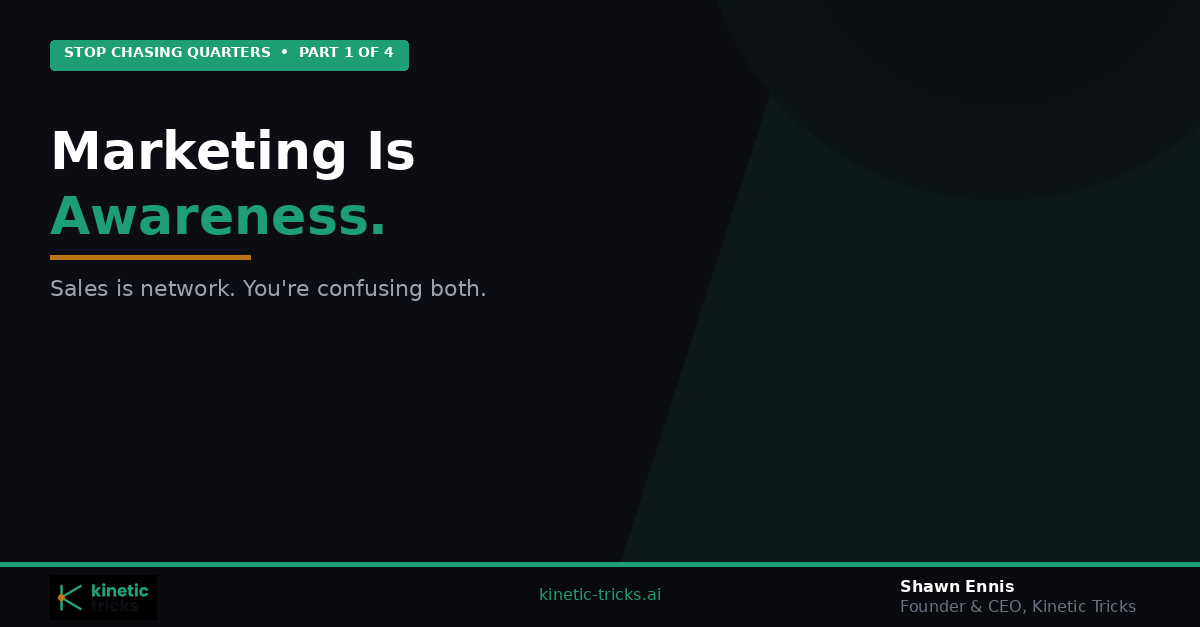
Marketing is awareness. Sales is network. Revenue is the outcome. Conflate them and your pipeline resets every quarter. Separate them and it compounds.
I built an entire playbook around this separation — the 10 traction tasks required to run awareness, network, and timing intelligence consistently, and the cost comparison between doing it manually versus with AI. It changed how I run GTM for both companies I operate today.
The full framework is in the white paper.
“Stop Chasing Quarters: How to Build a Pipeline That Pays You Back” — the compounding pipeline model, 10 traction tasks, and the real cost of revenue.
Or book 15 minutes: cal.com/shawn-ennis