The Quarters Rule: How One Founder Runs GTM Without Burning Out
The founders who survive the solo-led phase aren’t working more hours. They’re working the same hours with dramatically better structure. Here is the time allocation that makes founder-led GTM sustainable past $1M in revenue.
By Shawn Ennis · Founder & CEO, Kinetic Tricks · June 29, 2026
The instinct when you are overwhelmed is to add people. More hands, less work for any one person, faster progress.
This is wrong.
Adding people slows founders down. Each new person is another relationship to manage, another set of priorities to align, another performance question to assess. The founder’s time gets consumed by management, not by the work that grew the company in the first place.
The right move isn’t more help. It’s better leverage.
Leverage means doing the same work with less effort. It means turning one hour into three. It means having your Monday morning planning session produce the entire month’s strategy, not just the next deal. It means content drafted, pipeline reviewed, and outreach prepared before you’ve had your second coffee.
This isn’t a productivity hack. It’s a structural change in how the founder spends their time. And it’s the only way to make founder-led GTM sustainable past the first $1M in revenue.
Segment your time deliberately
Don’t do everything every day. Don’t reactively answer email at 6am, take customer calls all afternoon, write a blog post at 11pm, and wonder why you’re exhausted. Segment your time by activity type, and protect those segments.
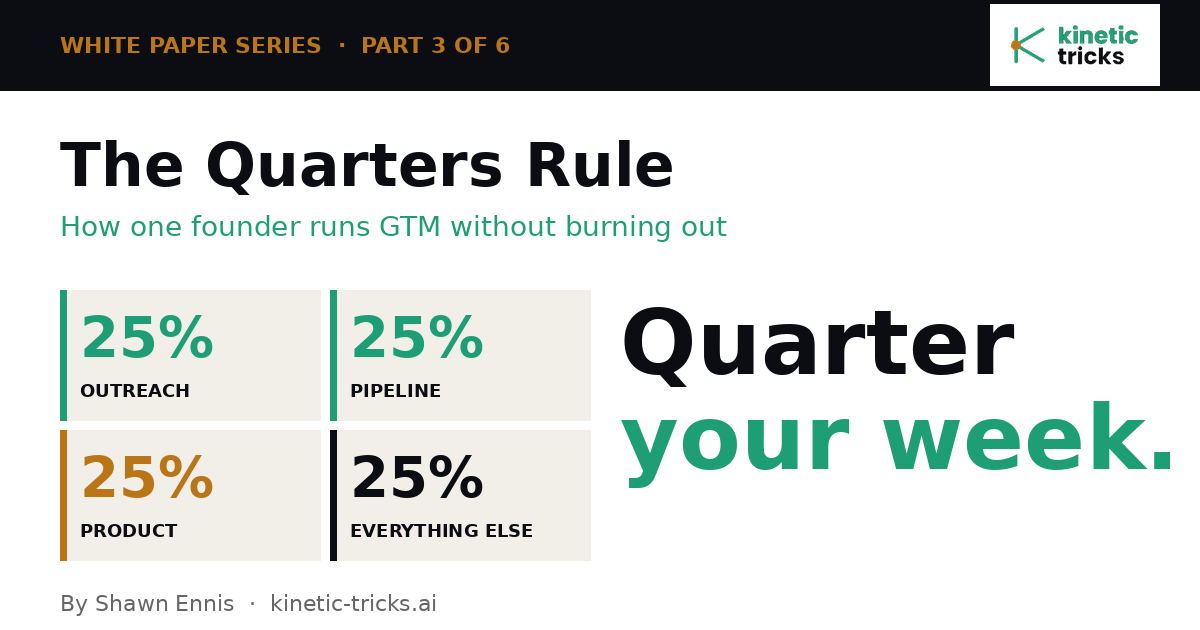
Here’s the time allocation that works for a solo founder running GTM:
- 25% Outreach – 10 hours/week. Targeting accounts, researching decision-makers, sending personalized messages, following up.
- 25% Selling – 10 hours/week. Daily review of every active deal. Five minutes per deal: what changed, what’s next, did you do it?
- 25% Product – 10 hours/week. Time in what you sell — improving it, expanding it to fit customer needs. Non-negotiable.
- 25% – Everything Else – 10 hours/week. Recruiting, training, marketing, strategy, fires. The swing block.
This is the practical, defensible allocation. Quarter your time, quarter again, and you have a working week.
Notice what’s not on the list as its own segment: content creation
That’s because content creation is what happens during the first four hours of your month, when you produce the thought leadership asset that drives everything else. The remaining content work — derivatives, social posts, blog versions — is downstream of that one strategic decision. AI agents handle the production. You handle the thinking.
Notice also that product gets 25%
This is non-negotiable for solo founders.
The 25% for product means time spent in what you sell your customer — improving it and expanding it to better fit your customer’s needs. For a software founder, that’s time in the code, in the architecture, in the next version. For a services founder, that’s time refining your methodology, expanding your offering, sharpening your deliverables. For a hardware founder, that’s time in the lab and on the manufacturing floor.
Whatever your product is, a quarter of your week belongs there. Sales people who don’t know the product lose deals. Marketers who don’t know the product produce content that doesn’t convert. Founders who lose touch with their product lose touch with their business.
This is also why hiring out the product is the worst possible delegation in early-stage. You can hire out marketing. You can hire out sales. You cannot hire out the product, because the product is the company.
Founders who hand the product to other people in the first three years are the founders whose companies never quite work.
Plan the month in the first four hours
Here’s what my first Monday of every month looks like:
I sit down and plan a single thought leadership asset for the month — typically a white paper, sometimes a case study, sometimes a deep-dive blog post. The topic comes from the conversations I’ve had over the previous month with customers, partners, and colleagues. It’s framed around how I can help my customer, not around what my product does.
That one asset becomes the brand centerpiece for the entire month.
From that asset, I derive everything else: a datasheet for sales, a pitch deck for prospects, a pricing calculator for budget conversations, multiple blog posts for inbound, social media posts for visibility, video content for engagement. Each derivative takes a fraction of the time the original took, because the thinking is already done.
By hour four of my work month, I have the complete sales and marketing strategy. I know what I’m saying. I know what I’m publishing. I know what I’m pitching. I know what I’m responding to inbound with.
The remaining hours of the month are spent executing that strategy, not figuring out what the strategy should be.
If you are not this efficient with your monthly planning, you will fail at solo-led GTM. Not because you’re not working hard enough, but because you’re spending your time on activities that don’t compound.
Re-deciding what to say every week is the opposite of compounding. Saying the same well-considered thing in five different formats across an entire month is what compounds.
Spend 25% of your time networking
Twenty-five percent. Roughly ten hours a week. Talking to industry leaders, customers, partners, competitors, and colleagues about what’s actually happening in your market.
This isn’t optional and it isn’t a nice-to-have. It’s the most important activity you do, because it determines whether your strategy is in touch with reality.
Here’s the brutal truth: you cannot sell a deal to a customer in 2026 if you’re walking and talking 2024. Markets shift fast. Buyer priorities change quarterly. The vocabulary your prospects use to describe their problems is different than it was a year ago. If you’re not in constant conversation with the people who buy from you and the people who sell to them, your messaging will become stale, and you won’t know it until your conversion rates collapse.
Networking is also where you find your future hires. Every conversation you have with a partner is a future hire interview. Every conversation with a competitor’s employee is a future opportunity. Every conversation with a former customer is a referral source. The network you cultivate today is the talent pool you hire from in three years.
If you’re spending less than 25% of your time on networking, you’re under-investing in the activity that drives everything else.
Focus on pipeline daily
Your pipeline is where the deals are. Review it daily. Not weekly, not “when you have time,” daily.
The reason daily review matters: deals don’t fail at the bottom of the funnel. They fail at the middle, when nobody is paying attention. A deal that’s been in “evaluation” for six weeks is a dead deal nobody has had the courage to call yet. A daily review catches these. A weekly review misses them.
Daily review means looking at every active deal and asking three questions:
- What changed since I last looked?
- What’s the next thing this deal needs to move forward?
- Have I done that thing, or do I need to do it today?
Five minutes per deal, fifty deals, four hours a week. This is non-negotiable.
I happen to use KForce to do this — Sage compiles a morning brief that surfaces deal changes, recommends next actions, and flags deals that have stalled. But the principle is more important than the tool. If you’re not reviewing pipeline daily through some mechanism, you’re losing deals you don’t know you’re losing.
Drive outreach with intent
The other side of pipeline is outreach: filling the top of the funnel with the right prospects.
Don’t do volume outreach. Don’t blast 500 generic LinkedIn messages and hope ten respond. That’s the activity of someone who doesn’t know who their customer is.
Do targeted outreach. Identify the specific accounts that you believe could use your product. Research who the decision makers are at those accounts. Find the second-degree connections that could introduce you. Send personalized messages that reference something specific to their company, their role, their recent activity.
The goal is to live in your customer’s world. The more you understand what they care about, what they read, who they listen to, what frustrates them, the easier it becomes to sell to them. Selling becomes a conversation, not a pitch.
The compound effect of the operating system
Each of these practices on its own is valuable. Together, they produce something more than the sum: a founder who is in the market, generating content, managing pipeline, and building relationships at a pace that previously required three or four people to sustain.
This is what “work smarter, not harder” actually means in practice. It’s not vague advice. It’s a specific allocation of time and a specific set of disciplines that, executed consistently, allow one person to operate at the capacity of a small team.
The fourth quarter — networking, recruiting, training, marketing, strategy, and the inevitable random fires — is the swing block. Some weeks it’s heavy networking. Some weeks it’s a contract you’re negotiating. Some weeks it’s prepping for an event. Some weeks it’s a customer escalation. The 25% absorbs the variability so the other 75% stays predictable.
If your week doesn’t roughly fit this allocation, you’re spending time on the wrong things.
What’s next
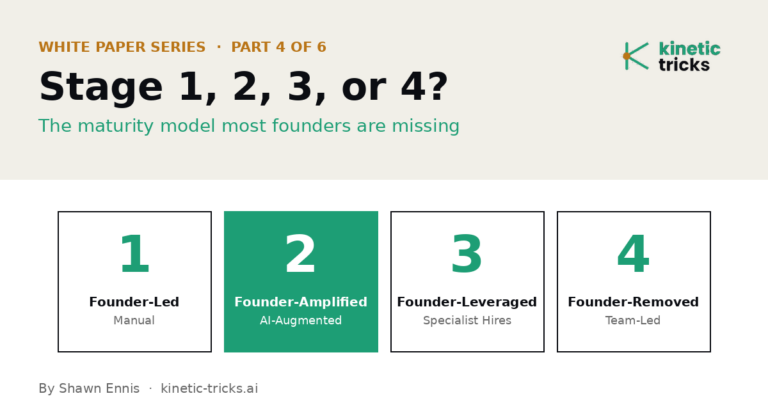
The Quarters Rule is the operating system. But knowing how to spend your time is only half the framework — the other half is knowing what stage of company maturity you’re actually in, and whether you’re trying to operate ahead of (or behind) where you should be.
That’s the four-stage maturity model. Most founders place themselves in Stage 3 when they’re actually in Stage 1. The gap is what’s hurting them.
Get the full framework: Avoiding the Hiring Trap
A 31-page framework including the four-stage maturity model, the network-first hiring playbook, and the three mechanisms that replace your first sales hire. Free download. Download the white paper →