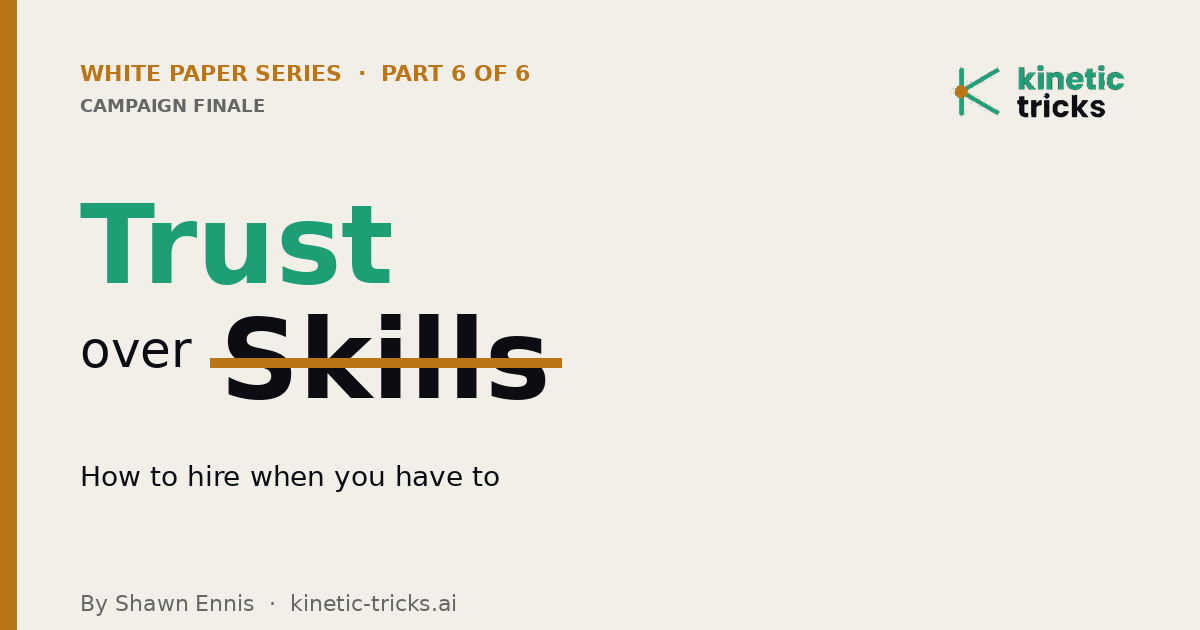
Trust Over Skills: How to Hire When You Have To
Sometimes you have to hire even when the framework says you shouldn’t. Your CFO insists. Your board pushes for it as a condition of capital. Here’s the rule that determines whether the hire works.
By Shawn Ennis · Founder & CEO, Kinetic Tricks · July 29, 2026
Over the past eight weeks I’ve made a case for delaying hires, for hiring from your network, for exhausting contract and reseller mechanisms first. The discipline of avoiding the hiring trap is the discipline of saying “not yet” — repeatedly, against pressure, for longer than feels comfortable.
But there’s a scenario where the framework above doesn’t apply.
Sometimes you have to hire even when you’d rather wait. Your CFO insists. Your investors require hiring as a condition of further capital or as a risk-mitigation measure. Your board sees a runway calculation that says “if the founder gets hit by a bus, the company dies in 30 days” — and they’re not wrong.
This happens. And when it does, the framework changes.
You’re not hiring for capacity — you’re hiring for risk reduction
If you find yourself in this situation, the first thing to acknowledge is that you’re solving a different problem.
Normally, the hiring decision is about operational need: there is work that can’t be done without another person, and the work has clear revenue tied to it. The hire takes work off your plate and produces measurable output.
Stakeholder-driven hiring is about risk reduction: the board wants someone who can keep the company running if the founder is unavailable. The investor wants the company to look less dependent on one person. The CFO wants succession depth.
These are legitimate concerns. But they require a different hiring strategy.
When you’re no longer hiring because the work demands it — you’re hiring to satisfy a stakeholder — the criteria for evaluating candidates must change.
The prioritization order changes
Skills and experience remain important. You cannot hire someone who doesn’t know your customers, your industry, or how to do the actual job. But the top criterion changes from “best skills match” to “deepest trust.”
Here’s the distinction that matters:
When you’re hiring under operational pressure, skills win.
The work needs to get done now. You need someone who can deliver on Day 30, not Day 90. The right hire is the one with the most directly applicable experience, the strongest references for the specific work, the cleanest track record of executing this role at companies like yours.
When you’re hiring under stakeholder pressure, trust wins.
The board needs a hire. You need succession risk reduced. The work itself isn’t the urgent need — the relationship is. The hire needs to be someone you can hand the keys to. Someone whose work you have personally seen across multiple contexts. Someone who would tell you the hard truths you don’t want to hear, and someone who would protect your company’s reputation in conversations you’ll never be present for.
This does NOT mean hiring people who don’t know what they’re doing. Culture and trust are more important than skills for stakeholder-driven hires. That doesn’t mean you should hire dummies, or people ignorant of your customers. The bar is competent AND trusted, with trust being the tiebreaker among competent candidates.
Why the prioritization order changes
When you’re hiring under stakeholder pressure rather than operational need, you’re going to be wrong about half of what you think the role needs to be. The hire will need latitude to figure out what the job actually is, and you’ll need to give them that latitude without micromanaging. Both of those require deep trust, in both directions.
Trust enables:
- Telling each other when something isn’t working
- Pushing back on each other without ego
- Operating with shared assumptions about how decisions get made
- Representing the company to outsiders consistently with the founder’s intent
- Handling the inevitable founder mistakes with grace instead of resentment
Skills can be sharpened with time and coaching. Industry knowledge can be acquired through immersion. But you cannot retroactively build trust with someone you didn’t know before you hired them. The trust either exists from prior shared experience, or it doesn’t.
How to find the right person
So when forced to hire, hire from the people you already trust deeply — but only from the ones who are also competent at the actual work.
Do not interpret “trust over skills” as “hire your friends regardless of capability.”
Friends who can’t do the job become problems much faster than strangers who can. The bar is: competent AND trusted, with trust being the tiebreaker among competent candidates.
The process for finding this person:
- List the people in your network who have the skills. Former colleagues. Former partners. Former competitors. People whose work you’ve personally seen and respected.
- From that list, identify the ones you deeply trust. Who would you tell the hard truths to? Who would you trust with sensitive customer relationships? Who would you let speak on behalf of the company at a board meeting?
- That’s your candidate pool. If it’s three to five people, you’re in good shape. Reach out to all of them.
- If the list is empty, do not hire under pressure.
What if you don’t have anyone like that?
If you don’t have anyone in your network who is both competent and deeply trusted, do not hire under pressure.
Tell the board and the CFO that the right hire doesn’t exist yet, and that hiring the wrong person will create more risk than it mitigates.
This is uncomfortable, but it’s true. The board’s risk concern is succession. A bad hire — one you don’t trust, one who doesn’t know your customers, one who turns out to be a poor cultural fit — creates more succession risk than the founder-only state.
Most boards will respect a founder who can defend that position with conviction. The ones who won’t are the ones who are going to make hiring worse, not better.
If you can’t push back, work with your investors on alternative risk mitigations:
- A formal succession plan that names a temporary leader if the founder is unavailable
- Key person insurance
- Cross-training of contract resources so multiple people understand critical functions
- Documented playbooks that allow others to operate the business in the founder’s absence
These don’t replace a hire long-term, but they address the actual concern (continuity) without forcing the wrong hire.
Don’t hire to grow. Hire to scale.
Growth is what AI-augmented founders can produce alone. Scale is what humans are still required for. The discipline to know the difference is what separates founders who build sustainable companies from founders who burn out trying.
If you’ve been following the series, the full framework is in the white paper. 31 pages, the complete playbook, free.
If you’re catching up at the end, the white paper is also where to start. The six blog posts in this series are derivatives of it — useful on their own, but the full framework holds together best in the original document.
Get the complete framework: Avoiding the Hiring Trap
A 31-page framework for solo founders, CEOs, and CROs deciding when AI agents are enough and when humans are essential. Free download. No spam. Download the white paper →
And when you’re ready to see how this works in practice — how AI agents handle the work that used to require hiring, so you can stay in Stage 2 as long as Stage 2 serves you — book a 15-minute conversation. I’ll show you what Stage 2 actually looks like when it’s running.