Three Mechanisms That Replace Your First Sales Hire
Before you make a salaried hire, exhaust three other mechanisms first. They cost less, carry less risk, and let you scale revenue without scaling headcount. I’m running all three at my current company right now.
By Shawn Ennis · Founder & CEO, Kinetic Tricks · July 20, 2026
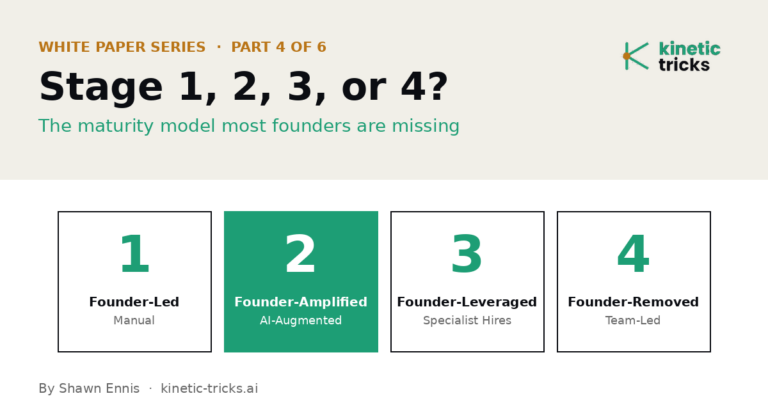
Stage 3 is when you bring in additional human capacity. But “hire” is not the only mechanism — and it shouldn’t be the first one.
Most founders skip directly to hiring because that’s the only mechanism they were taught. The hiring playbook is well-trodden. Job descriptions, interviews, offers, onboarding — every founder has seen this process. The alternatives are less visible, but they’re dramatically better economics for early-stage companies.
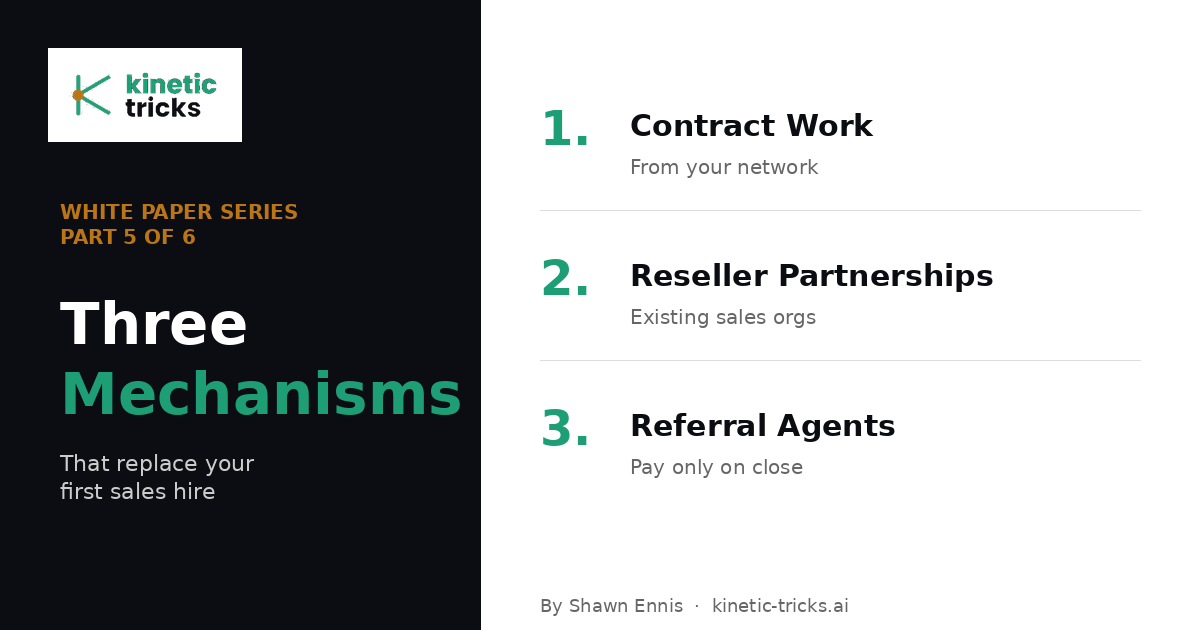
Here are the three mechanisms in order of preference. Each one should be exhausted before you consider the next.
1 Contract work from your network
Before you make a salaried hire, find someone in your network who can do the specific work on a contract basis. Training delivery, customer deployment, implementation services — these are well-suited to contract arrangements.
You pay only for the work delivered. They take the work because they trust you and the price is fair. Neither party commits to a long-term relationship until both parties have verified the fit.
Contract work also has a hidden benefit: it’s a trial period for what could become a future hire. You see how they work. They see how you operate. If the fit is right and the work persists, the conversion to full-time is natural and low-risk.
The work types that fit this model:
- Customer onboarding and training delivery. Paid per engagement. Contractor handles 1-2 customers at a time.
- Implementation and deployment services. Project-based pricing. Contractor handles full deployment lifecycle.
- Sales engineering for specific deals. Hourly or per-deal. Contractor handles technical demos and proof-of-concepts.
- Marketing campaigns. Project-based. Contractor handles specific campaign from strategy to execution.
The pattern is consistent: identify a specific deliverable that has a clear definition of “done,” and find someone in your network who can deliver it for a defined fee. No salary, no benefits, no long-term commitment.
2 Reseller and referral arrangements for sales
Don’t hire a sales person until you’ve exhausted reseller and referral options.
Resellers are companies that already sell complementary products to your target buyers. They have existing customer relationships, sales infrastructure, and credibility. A reseller arrangement gives you incremental revenue without payroll.
The economics are different — you give up margin instead of paying salary — but the risk is fundamentally lower.
I have signed reseller partners actively selling Rapax into accounts I would never reach alone. They take a meaningful share of margin on closed deals. In exchange, they’re handling the sales motion — discovery, demos, negotiation, close. I handle the product expertise and the deal architecture.
Compare the economics:
Hire a sales person $120-200K loaded cost annually. 6-9 months to ramp. 18-24 month average tenure. No guarantee they can sell into specific accounts. Pay whether or not deals close.
Sign a reseller Share of margin only on closed deals. Their sales team already paid for. Existing customer relationships. Zero risk if deal doesn’t close.
For a long-cycle business that hasn’t reached scale, the reseller mechanism is dramatically better economics than hiring.
Referral agents are the other half
Referral partners are individuals or companies in your network who refer business to you in exchange for a finder’s fee. Cost: percentage of closed business. Risk: zero, because you only pay on closed revenue. Quality: high, because referred deals close at 3-5x the rate of cold prospects.
I have referral agents — many of them — actively looking for deals to send my way. No retainer, no draw, no fixed cost. They get paid when I get paid.
Why this works: my referral agents collectively have a network ten or twenty times larger than mine. They’re seeing opportunities I’d never find on my own. The cost is zero until a deal closes. The cost is bounded once it does.
A 10% referral commission feels expensive until you do the math. If you close $1M in revenue through a referral agent, you pay $100K. That same $1M closed through a salaried hire costs you their full annual salary plus benefits plus ramp time plus management overhead — and you carry the cost whether they close anything or not.
A well-run reseller and referral program can sustain growth from $1M to $5M ARR without hiring a single sales person.
3 Specialist hires when you have a specific revenue-generating role
Only after contract work has proven the function and reseller/referral partnerships have been exhausted should you make a salaried hire.
The hire should be:
- A specialist, not a generalist (closer, customer success lead, sales engineer, partner manager)
- Tied to a specific revenue outcome that exists now, not revenue you hope to generate
- Someone from your network whose work you have seen
- Compensated competitively in cash, not equity-loaded
- Backed by 18-24 months of runway
This is the discipline that produces good hires. Every shortcut from this discipline produces bad ones.
The composite picture
Between resellers, referral agents, and my own founder-led activity (augmented by AI agents), I have the effective coverage of a sales organization that would cost a small fortune if I were doing it through hiring. The actual cost: the reseller margin and referral commissions, which only get paid when deals close. The variable-cost structure is what makes this viable for an early-stage company.
The pipeline isn’t built by hiring. The pipeline is built by leveraging existing networks and existing infrastructure that other companies have already paid to build.
My job is to make those external resources productive, not to recreate them inside my own company.
When does this actually trigger hiring?
The framework I’m applying is not “never hire.” It’s “hire when the math actually requires it.”
The math requires hiring when:
- Pipeline exceeds founder capacity to manage. When deals are slipping because you cannot personally engage with every one, you need help shepherding them.
- Deployment volume exceeds contract resource capacity. Once you have enough closed business that contracted deployment specialists can’t handle the volume, you’ll hire a full-time deployment lead.
- Reseller volume requires dedicated management. When the reseller partnerships are generating enough deal flow that they need full-time relationship management, a partner manager becomes justified.
In each case, the trigger is revenue, not milestone. Don’t hire at $1M ARR because that’s “when you’re supposed to.” Hire when there is specific revenue-generating work that cannot be handled by the existing mechanisms.
And in each case, the hire should come from your network. By the time you make a hire under this framework, you should already know who they are. You’ve worked with them, watched their work, trusted them with deals before. The decision to hire them isn’t a hiring decision; it’s a contract conversion.
This is what Stage 3 hiring looks like when it’s done well. The hire isn’t a leap of faith. It’s the natural progression of a relationship that has already been working in a less-committed form.
The full hiring framework
The three mechanisms are the alternative to hiring. The white paper covers the full framework — including when hiring genuinely makes sense, who to hire, the runway you need, and the trust-over-skills rule for hiring under pressure.
Get the full framework: Avoiding the Hiring Trap
31 pages of practical framework — including the four-stage maturity model and the network-first hiring playbook. Free. Download the white paper →